CarbonUnits.com

The verified carbon market is not contracting. It is becoming more precise. Regulatory frameworks...
Carbon Credit Quality in 2026: A Buyer's Guide
In the first half of 2026, a top-rated reforestation credit sold for around $28. A low-rated credit from the same category sold for barely a third of that. That difference is the defining feature of the carbon market in 2026. The market has split into tiers. High-integrity credits command rising prices. Low-quality credits sit unsold. Overall value held near $1.4 billion in 2025, a fourth consecutive steady year, and the volume dip early in 2026 traces largely to one buyer, Shell, taking a step back. For a buyer, the shape of the market now matters more than its size. The question worth asking is whether the credits you buy can prove what they claim.
 Field experts inspecting a reforestation project, collecting data used to verify the quality and impact of carbon credits. AI generated picture.
This guide maps the market a buyer meets in 2026. It opens with how the market arrived here, from the hype and backlash of the early 2020s through the integrity reset that followed. From there, the focus turns to why high integrity now functions as the entry requirement, and how the Core Carbon Principles, the VCMI, and the SBTi have redrawn the baseline. It sets out where price divides along quality, with investment-grade credits pulling clear of the rest. A closer look at low-rated credits explains the reputational and financial risk that outlasts their low price. The guide ends with the practical steps that turn all of this into a sound procurement decision.
From Hype to Professionalisation
The five-year trajectory of the voluntary carbon market (VCM) explains the shift. From 2021 to 2023, the market grew rapidly on rising corporate demand, then drew growing criticism as investigations questioned whether many credits delivered the emissions reductions they claimed. 2024 and 2025 brought the integrity reset: new standards, fresh scrutiny, and a clear-out of inconsistent methodologies. 2026 is the professionalisation phase. Carbon data providers, standard-setters, and buyers now describe the same pattern of more data, more regulation, and sharper separation between high and low-quality assets. Sylvera, Ecosystem Marketplace, Green Earth and South Pole each frame the year in these terms. The consistent thread is professionalisation. Quality now sets the terms of the market.
Two large buyers can distort the headline. The first-half fall in retirements is mostly one company, Shell, taking a step back. The forward market tells a matching story: its steep drop in announced offtake volumes traces largely to Microsoft, whose commitments fell 82% year on year. Set those two aside and the picture inverts. Non-Microsoft forward demand grew 73%. Biochar purchases rose 79% to reach 36% of forward market value (Sylvera). A second tier of buyers is broadening the market as the largest players pause.
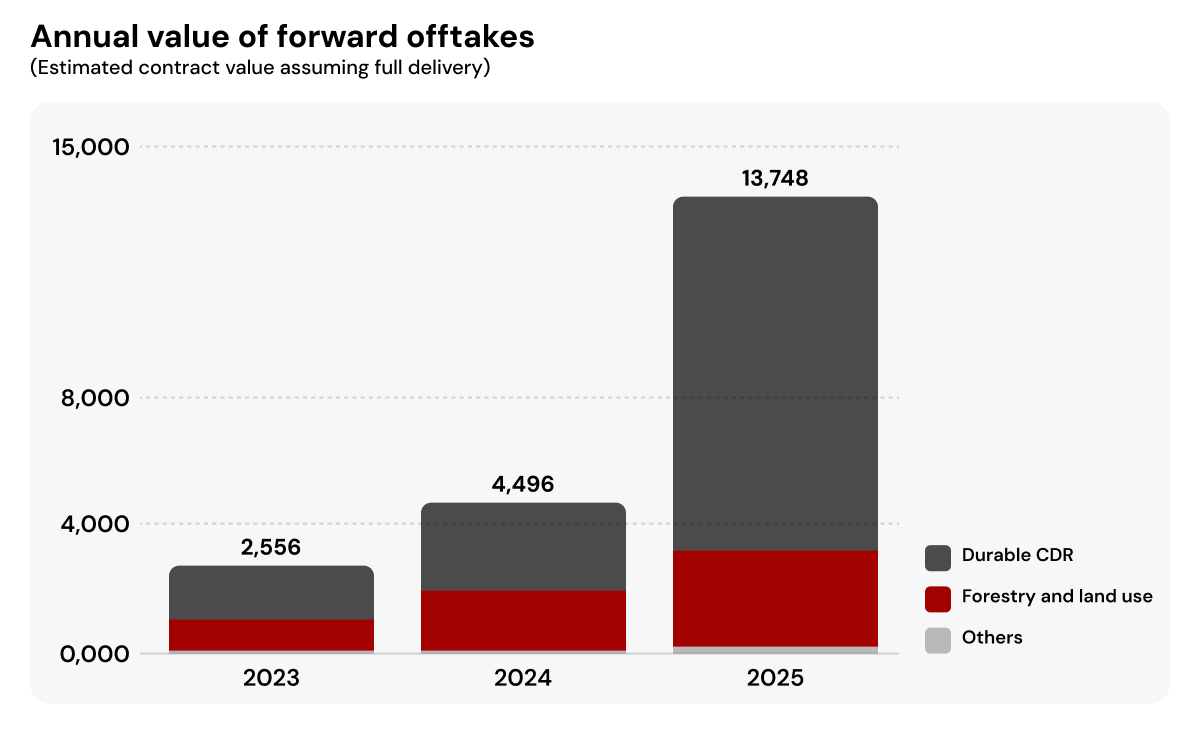 Annual value of forward offtakes. Source: Sylvera.
High Integrity Is Now the Baseline
For years, high integrity was a way for a project to stand out. In 2026 it is the entry requirement. Three developments moved it there.
The Integrity Council for the Voluntary Carbon Market (ICVCM) sets a market-wide quality benchmark through its Core Carbon Principles (CCPs). Credits from approved programmes and methodologies carry a CCP label (ICVCM). That label now steers real money. Ratings data shows CCP-aligned projects cluster at the higher grades, with 36% holding a BBB rating and a further 36% at B. Projects without the label concentrate at the bottom, a quarter rated C and almost a fifth rated D. Buyers increasingly use CCP status as a first-pass filter, and supply is responding: CCP-accredited issuance grew from under 3% in 2023 to 27.5% by the second quarter of 2026.
The Voluntary Carbon Market Integrity Initiative (VCMI) addresses the demand side, the counterpart to the ICVCM's work on supply. Its Claims Code of Practice sets the conditions a company meets before it publicly states that it has used carbon credits. The company first reports its emissions, sets near-term reduction targets, and cuts its own emissions in line with them; credits then apply to the emissions that remain. On that basis it can make a tiered Carbon Integrity Claim, from Silver to Platinum, scaled to how much of its remaining emissions it compensates with high-quality credits. From January 2026, those credits carry a CCP approval or qualify under Article 6.4, tying the claims framework directly to the ICVCM quality bar.
The Science Based Targets initiative (SBTi) completed the shift. Its Corporate Net-Zero Standard V2, released in 2026, recognises carbon credits for the first time inside a science-based framework, covering ongoing emissions responsibility beyond a company's own reductions.
Together, these frameworks define that floor. High-integrity carbon credits are those that clear it. Credits that fall short are increasingly difficult to sell.
Price Is Splitting by Quality
The clearest signal of professionalisation lies in the prices. The market has always priced credits across a wide range. In 2026 that range is widening, and it widens along the line of quality.
Investment-grade credits (those rated BBB or higher) made up 27% of rated retirement volume in the second quarter of 2026 and 51% of rated market value. Just over a quarter of the credits carried half the money.
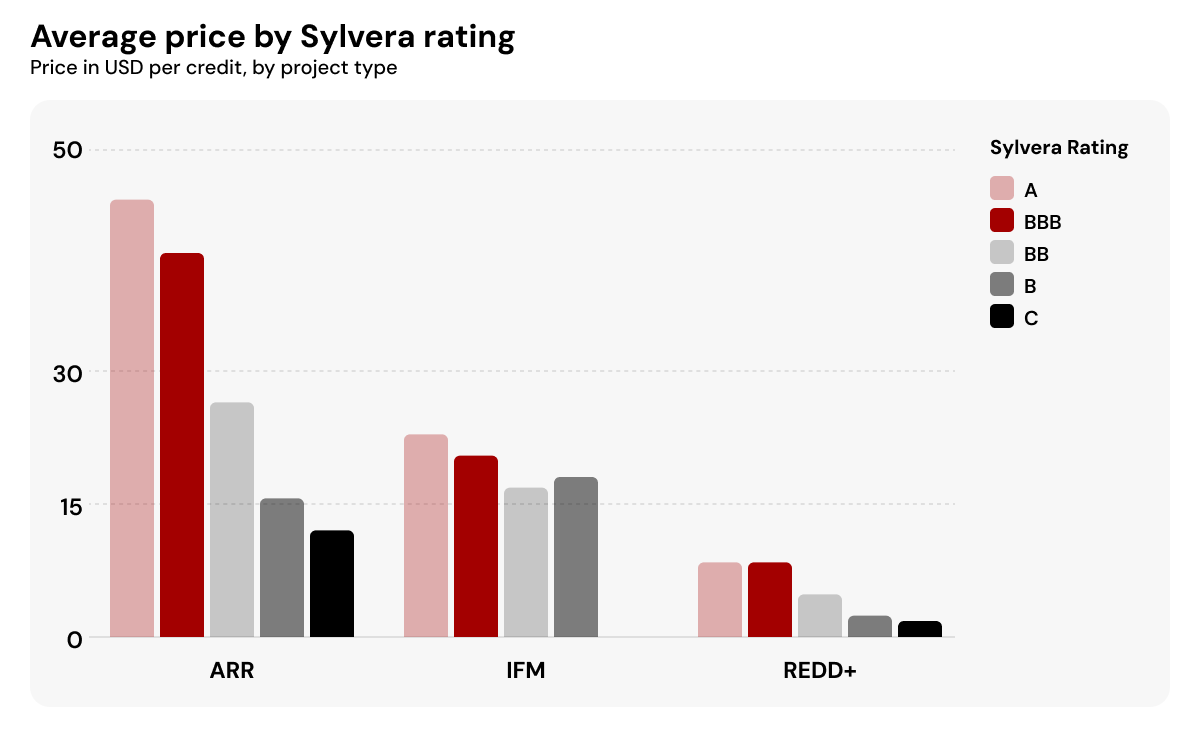 Average prices according to project type (afforestation, improved forest management, and REDD+), and quality rating. Source: Sylvera.
The pattern holds inside each project type. For afforestation, reforestation, and revegetation (ARR), BBB+-rated credits sold for an average of $28.55 in the first half of 2026, against $9.12 for lower-rated ARR, a quality premium of more than three times. In REDD+ (reduced emissions from deforestation and forest degradation), high-rated credits rose 71% year on year to $8.40, and low-rated credits fell 26% to $1.82. The gap between them more than doubled in a single year. Improved forest management shows the same widening spread.
New supply is following the money. Investment-grade issuance climbed from 13–16% across 2022 to 2024, to 25% in 2025, to 29% in the first half of 2026. The lowest-rated issuance, credits graded C and D, fell from 43% of the rated pool to 22% over the same window. Carbon credit quality in 2026 is measurable, and the market prices it.
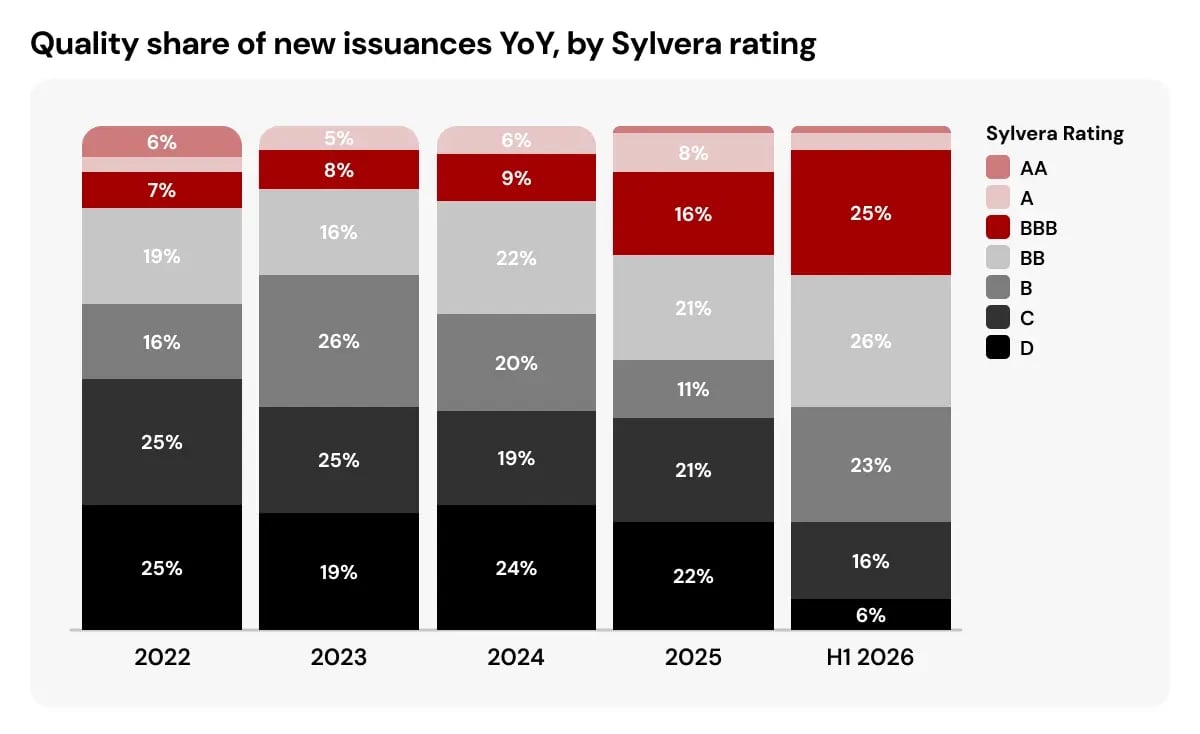 Quality share of new issuances. Source: Sylvera.
Cheap Credits Carry a Rising Cost
Low prices look like savings. In 2026 they increasingly signal risk, of two kinds.
The reputational risk is well documented. In 2023, investigations by journalists and academics found that many forest-protection credits overstated their climate benefit. A study published in the journal Science examined a set of REDD+ projects and found limited evidence that they reduced deforestation against comparable areas. Carbon Market Watch reached similar conclusions on overstated baselines and understated leakage. Companies that had bought heavily into these credits faced public criticism and quiet write-downs. The credits were cheap. The exposure was expensive.
The financial risk is newer, and it is structural. Low-rated credits are accumulating unsold, forming a growing inventory that serious buyers pass over. A credit that no buyer wants is a credit that may never be used at face value. Regulation is sharpening the point. The European Union's Empowering Consumers Directive, in force from September 2026, restricts generic environmental claims built only on purchased credits. Corporate reporting rules place credits in a separate category from a company's own emissions reductions. SBTi's recognition applies to high-integrity credits. A cheap, low-rated credit buys less and less: less reputational cover, less regulatory standing, less usable claim.
The savings on the purchase price is real. The cost tends to show up later.
What Professionalisation Means for Buyers
For a buyer entering the market in 2026, the practical implications are direct.
- Treat quality as the starting point rather than an upgrade. Set a minimum rating or require a CCP label as a first-pass filter, the way a growing share of buyers already do.
- Budget for the premium. High-integrity credits cost more, and the gap keeps widening. A procurement plan built on last year's average price will fall short. Model prices by project type and by quality tier.
- Plan forward. Demand for credible supply is set to tighten. SBTi's V2 standard implies a substantial step-up in credit use among the roughly 11,000 companies with science-based targets, a group that retired the equivalent of a fraction of a percent of its footprint last year. Aviation adds more pressure: under the Carbon Offsetting and Reduction Scheme for International Aviation (CORSIA), only a small share of potentially eligible credits currently meets every requirement, against demand that rises toward a 2028 deadline. Buyers who secure quality supply early carry less price risk later.
- Build a portfolio. Mix project types, geographies, and durability. A spread of high-rated credits manages delivery and policy risk better than a single large position in the cheapest option available.
Buying the Right Credits in 2026
The split in prices points one way. Weak credits are losing value. Credible ones are gaining it. The professionalisation of 2026 favours the buyer who approaches the market on its current terms: quality treated as the starting point, price assessed in light of that quality, and supply secured with attention to the frameworks tightening around it. The credits that hold their value are those that can substantiate what they claim.


_Two%20people%20talking%20and%20working%20in%20an%20office_featured.webp?width=600&name=Who%20is%20Buying%20Carbon%20Units%20(and%20Why)_Two%20people%20talking%20and%20working%20in%20an%20office_featured.webp)