CarbonUnits.com

Small and medium-sized enterprises (SMEs) comprise around 90% of businesses globally, accounting...
The SME Opportunity: Why Small and Medium-Sized Enterprises Should Pay Attention to Carbon Units
For years, the conversation around corporate environmental action has focused on the giants: the multinationals with sustainability departments, ESG officers, and net-zero targets stamped across their annual reports. Small and medium-sized enterprises (SMEs) have largely watched from the sidelines, often assuming the topic was too complex, too expensive, or simply too big for a business of their size.
 Small company team analyzing its corporate environmental actions and net-zero targets. AI generated picture.
That assumption no longer holds.
SMEs make up the engine room of the global economy. According to the OECD, they account for around 99% of all firms and roughly 70% of employment in OECD countries. Their collective environmental footprint is correspondingly significant, and the pressure to measure, manage, and communicate that footprint is now arriving at their doorstep—from customers, lenders, regulators, and the larger companies they supply.
The good news is that the voluntary carbon market offers SMEs a practical, scalable way to act. This article unpacks why SMEs should be paying attention to carbon units, how to engage credibly, and how to communicate the work to stakeholders.
Why the Pressure on SMEs is Rising
The shift is not abstract. Three forces are converging.
Supply chain demands from larger corporations. Big buyers are setting science-based sustainability targets, and a substantial share of their emissions sits in Scope 3, meaning the footprint of their suppliers. CDP's supply chain programme reports that more than 24,000 suppliers were asked to disclose environmental data through its system in recent reporting cycles, with disclosure increasingly tied to procurement decisions. If you supply a listed company, you can expect a questionnaire in your inbox sooner rather than later.
MEASURE YOUR PRODUCT’S FOOTPRINT
Regulation cascading downward. In the European Union, the Corporate Sustainability Reporting Directive (CSRD) requires large companies to report on their value chains. That obligation flows directly through to SMEs that supply them. Listed SMEs face their own simplified reporting requirements, and a voluntary standard for non-listed SMEs has been developed by the European Financial Reporting Advisory Group (EFRAG) to help smaller firms respond consistently.
Customer and finance expectations. Banks are integrating environmental criteria into lending decisions. Insurers price climate-related risk. Consumers, particularly in B2C segments, increasingly choose suppliers with credible environmental credentials. None of this is going away.
For SMEs, the question is no longer whether to engage, but how to do so without breaking the budget or making claims they cannot defend.
The SME Carbon Footprint: A Starting Point
Before any business considers carbon credits, the foundation has to be fixed in measurement. The principle is straightforward: measure, reduce, then compensate for what cannot yet be eliminated.
A basic SME carbon footprint covers three scopes:
- Scope 1: direct emissions from sources the business owns or controls, such as company vehicles or on-site fuel combustion
- Scope 2: indirect emissions from purchased electricity, heating, and cooling
- Scope 3: all other indirect emissions across the value chain, including purchased goods, business travel, and employee commuting
 3 scopes illustration.
For most SMEs, Scope 3 is the largest and hardest to measure. Green Earth's CO2 Expert tool is a free online business carbon footprint calculator that covers all three scopes and walks companies through the process with expert guidance, giving businesses a clear, structured starting point for understanding their value chain impact.
For SMEs that prefer a peer-supported community, the SME Climate Hub, a global initiative backed by the We Mean Business Coalition, the Exponential Roadmap Initiative, and the UN Race to Zero campaign, offers a complementary commitment framework for businesses with fewer than 500 employees. Both are credible, low-cost places to begin.
Once measurement is in place, the next step is a reduction plan: energy efficiency, electrified transport, renewable electricity contracts, supplier engagement. Carbon credits enter the picture for the portion of emissions that cannot yet be reduced—the hard-to-abate residual.
SME Carbon Credit Options: What is Actually Available
The verified carbon market has evolved considerably. SMEs now have access to a range of credit types, broadly grouped into two families.
Nature-based credits. These come from projects that protect, restore, or sustainably manage ecosystems—reforestation, afforestation, mangrove restoration, regenerative agriculture, and avoided deforestation. They deliver carbon sequestration alongside biodiversity, water, and community co-benefits.
 Bulindi chimpanzees in their natural habitat in Uganda, as a part of Bulindi Agroforestry and Chimpanzee Conservation Project, Green Earth. Source: https://www.green.earth/projects/bulindi-chimpanzee-habitat-restoration-project-uganda
Technology-based credits. These include credits from improved cookstoves, biochar, renewable energy, methane capture, and emerging engineered removals such as direct air capture. They tend to focus on a single emissions pathway and can carry higher price points, particularly for permanent removal technologies.
A balanced portfolio often draws from both. The right mix depends on a business's sector, its values, the messages it wants to send to stakeholders, and its budget.
Prices vary widely—from a few euros per tonne for some avoidance credits to several hundred euros for engineered removals. According to Ecosystem Marketplace's annual State of the Voluntary Carbon Markets report, buyers are increasingly willing to pay a premium for credits with strong integrity signals, robust co-benefits, and clear additionality.
How to Choose Quality Credits
This is the question SMEs ask most often, and rightly so. The market has faced legitimate scrutiny over the past few years, and any business buying credits needs to be confident in what it is paying for. Five criteria matter.
Additionality. The project must deliver emissions reductions or removals that would not have happened without the carbon finance. Without additionality, a credit is just paperwork.
Permanence. The carbon stored or avoided needs to stay out of the atmosphere for a meaningful period. Look for projects with buffer pools, monitoring plans, and clear risk assessments.
Measurable and verifiable. Reductions must be quantified using transparent methodologies and verified by an independent third party. The major standards—Verra's VCS, the Gold Standard, the Climate Action Reserve, and Plan Vivo—provide the underlying frameworks.
No leakage. A reforestation project that simply pushes deforestation into the next valley does not actually reduce emissions. Quality projects monitor and account for leakage.
Strong co-benefits and safeguards. The best projects support local communities, protect biodiversity, and respect the rights of Indigenous peoples and local stakeholders.
To navigate this, look for credits that meet the Core Carbon Principles set out by the Integrity Council for the Voluntary Carbon Market (ICVCM). The ICVCM was established to set a global threshold of quality for the market, and credits carrying the CCP label have been independently assessed against this benchmark. It is one of the clearest signals an SME buyer can rely on.
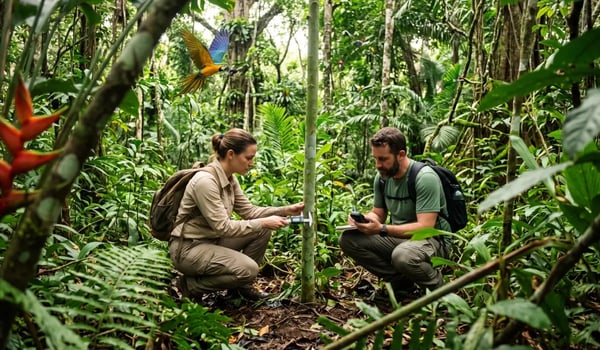
 A person actively verifying measurements on-site to ensure independent validation and measurable environmental impact in high-quality carbon credit projects. AI generated picture.
Voluntary Carbon Market for SMEs: Practical Entry Points
Engaging in the verified carbon market does not require a sustainability department. A typical SME pathway looks like this:
- Measure the business' footprint, using a free tool such as the SME Climate Hub calculator or a sector-specific equivalent;
- Set a reduction commitment: the SME Climate Hub commitment is recognised by the UN Race to Zero campaign and signals seriousness to stakeholders;
- Build a reduction plan focused on the biggest emissions sources;
- Identify the residual footprint that cannot yet be reduced;
- Purchase verified carbon credits to compensate for hard-to-abate emissions, prioritising quality over quantity;
- Report progress annually, transparently, and with the same evidence trail used internally.
Many SMEs start small: compensating for the emissions of a single product line, a flagship event, or a specific service, and expand as confidence grows. There is no requirement to compensate for the entire business in year one. A staged approach is often more credible than an over-ambitious headline figure.
How to Communicate With Stakeholders Without Overclaiming
This is where many businesses, large and small, have run into trouble. The era of slapping the word 'neutral' on a product without substantive backing is over. Regulators in the EU and the UK have moved against unsubstantiated environmental claims, and consumers are increasingly sceptical of marketing language that outruns the underlying action.
The safer path is to describe what has actually been done, in plain language. A few principles help:
- State the measurement: 'In 2024, our footprint was X tonnes of CO2 equivalent'
- State the reduction: 'We have reduced this by Y% since our baseline year through specific actions'
- State the compensation: 'We have compensated for the remaining Z tonnes through verified carbon credits from a specific project type'
- Name the standard: tell stakeholders which independent standard verified the credits
- Avoid superlatives that the data cannot support
The Voluntary Carbon Markets Integrity Initiative (VCMI) has published a Claims Code of Practice that gives businesses a tiered framework—Silver, Gold, Platinum—for making credible claims based on the quality of their underlying action. For SMEs, even adopting the language and structure of this framework, without formally seeking a tier, signals to stakeholders that the business takes integrity seriously.
The goal is not to be the loudest voice. It is to be a credible one.
The Opportunity, Not the Obligation
It would be easy to read all this as a list of new burdens piling onto businesses that already have enough on their plate. That framing misses the point.
Engaging with the verified carbon market is, for many SMEs, a competitive advantage in the making. It opens doors with larger buyers running supplier programmes. It strengthens relationships with banks and insurers. It differentiates a business in tender processes. It supports recruitment and retention, particularly among younger workers. And it positions the business for a regulatory landscape that is moving in one direction only.
SMEs have always been agile. They make decisions faster than large corporates and can pivot when the environment shifts. The businesses that act now—measuring, reducing, and compensating with credibility—will be the ones best placed to thrive as the market matures.
 A small company team analyzing nature-based projects opportunities and considering investing in them. AI generated picture.
The verified carbon market is no longer a club for the largest companies. It is open, accessible, and increasingly designed with smaller businesses in mind. The opportunity is to step in early, choose well, and tell the story honestly.